Books
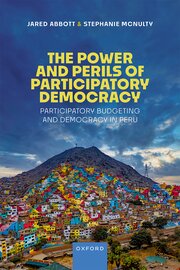
The Power and Perils of Participatory Democracy (2026, Oxford University Press) explores participatory democratic institutions’ (PIs) effect on the quality of democracy and citizens’ satisfaction with democracy. It demonstrates that participatory innovations are improving several aspects of democracy in the “least likely” case of Peru. Information sharing that takes place year after year, mostly due to a law that mandates PIs in all districts, has led to discernible changes in democracy and well-being. The book also identifies a range of implementation failures and design flaws, in addition to several larger structural political and social factors, that have substantially muted PIs’ utility as a tool for strengthening Peruvian democracy at the national level. The book employs original quantitative and qualitative data gathered over twenty years to undertake the first mixed-method, longitudinal analysis of government-mandated PIs and contributes to our understanding of local government, local development, participatory democracy, citizen engagement, and the quality of democracy around the world.
Participatory Budgeting in Global Perspective traces the origin and expansion of this democratic innovation and presents a unique theory of change to account for how PB programs theoretically produce social and political change. It provides in-depth explanation of the variation in PB program design and develops a clear typology of PB programs. With chapters on PB in Latin America, North America, Asia, and Africa, if offers a cross-regional comparative analysis of Participatory Budgeting programs and demonstrates how outcomes generated by PB will vary depending on PB type.
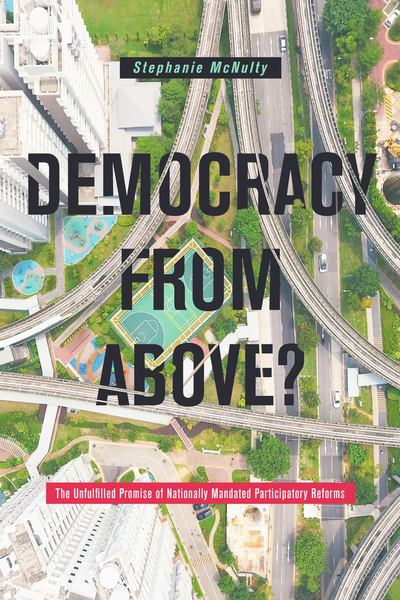
People are increasingly unhappy with their governments in democracies around the world. In countries as diverse as India, Ecuador, and Uganda, governments are responding to frustrations by mandating greater citizen participation at the local and state level. Officials embrace participatory reforms, believing that citizen councils and committees lead to improved accountability and more informed communities. Yet there’s been little research on the efficacy of these efforts to improve democracy, despite an explosion in their popularity since the mid-1980s. Democracy from Above? tests the hypothesis that top-down reforms strengthen democracies and evaluates the conditions that affect their success.
Listen to a podcast about Democracy from Above? here.
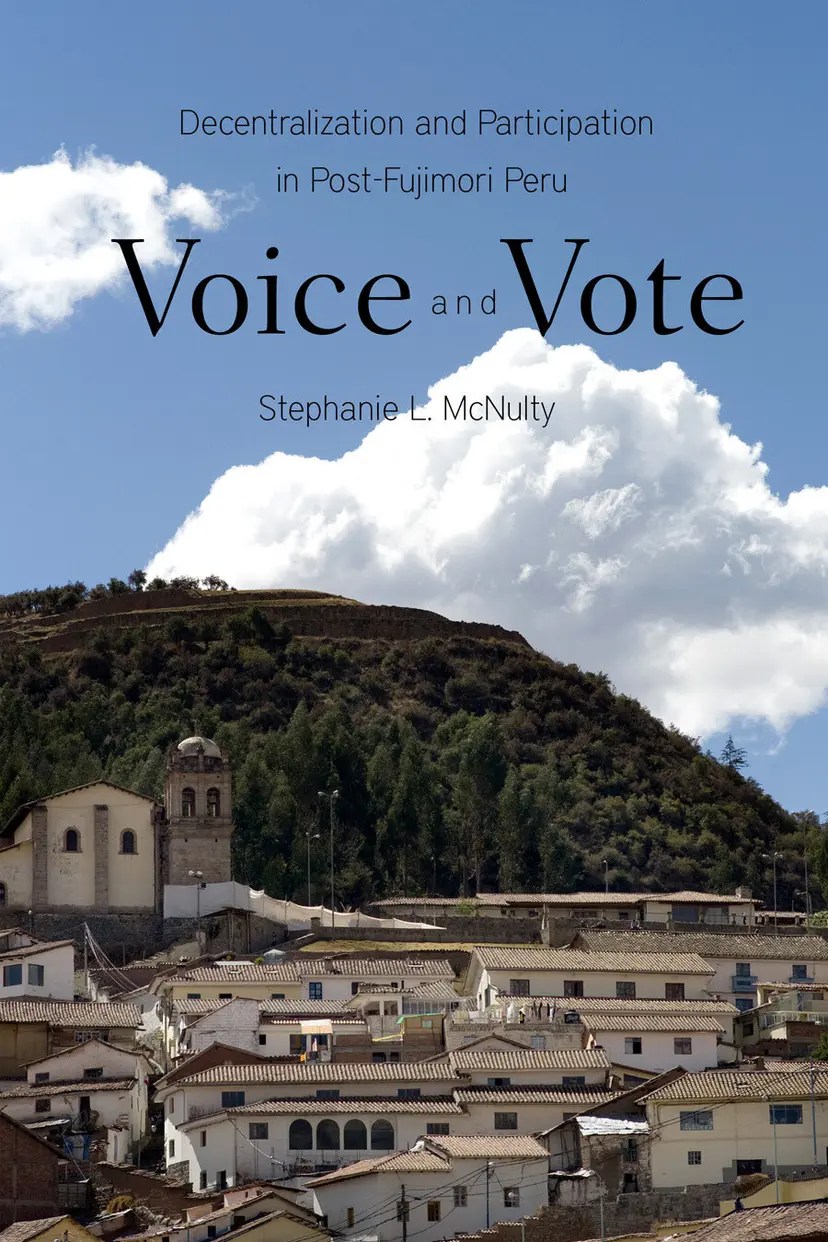
Voice and Vote explores the possibilities and limitations of a decision to restructure political systems in a way that promotes participation as part of second generation neoliberal reforms. The analysis o demonstrates the power that political, historical, and institutional factors can have in the design and outcomes of participatory institutions. Using original data from six regions of Peru, political scientist Stephanie McNulty documents variation in the implementation of participatory decentralization reforms and delves into the factors that explain this variation, and points to regional factors as prime determinants in the success or failure of participatory institutions.
Articles
2023. “Technocracy for the People? The Impact of Government Imposed Democratic Innovations on Governance and Citizen Well-being.” Co-authored with Jared Abbott and Katherine McKiernan. Comparative Political Studies 57(2): 187-220. Translated and Summarized in Nexo Acadêmico.
2023. “Participatory Budgeting and Well-being: Governance and Sustainability in Comparative Perspective.” Journal of Public Budgeting, Accounting & Financial Management. Co-authored with Brian Wampler and Mike Touchton.
2023. “Participatory Budgeting and Community Development: A Global Assessment.” American Behavioralist Scientist. Co-authored with Brian Wampler and Mike Touchton. https://doi.org/10.1177/00027642221086957
2019. “Participación decepcionante: una evaluación de quince años de la Ley Nacional del Presupuesto Participativo.” Revista de Ciencia Política y Gobierno (11), 7-30.
2018. “Embedded Exclusions: Exploring Gender Equality in Peru’s Participatory Democratic Framework.” Global Discourse 8(3), 532-549.
2018. “Politics and Promise: Exploring Fifteen Years of Peru’s Participatory Decentralization Reform.” Co-authored with Gustavo Guerra García. Public Organization Review 19(1): 45-64.
2017. “Perú 2016: Continuity and Change in an Electoral Year.” Revista de Ciencia Política 27(2). 563-587.
2015. “Barriers to Participation: Exploring Gender in Peru’s Participatory Budget Process.” Journal of Development Studies 51(11). 1429-1443.
2014. “Mandating Participation: Evaluating Guatemala’s Top Down Participatory Governance System” Pensamiento Propio 40. Special issue on “Citizen Participation in Latin America.”
2013. “Participatory Democracy? Exploring Peru’s Efforts to Engage Civil Society in Local Governance.” Latin American Politics and Society 55(3). 69-92.
2012. “An Unlikely Success: Peru’s Top-Down Participatory Budgeting Experience,” Journal of Public Deliberation 8(2), Article 4. Special Issue on “The Spread of Participatory Budgeting Across the Globe.”
Non-refereed Articles
2018. “Peru’s Struggle with the Fujimori Legacy.” Current History 117 (796): 56-61.
2017. “The Fujimori Effect: Political Instability and Paralysis in Peru.” NACLA. December 29.
 Dr. Stephanie L. McNulty